


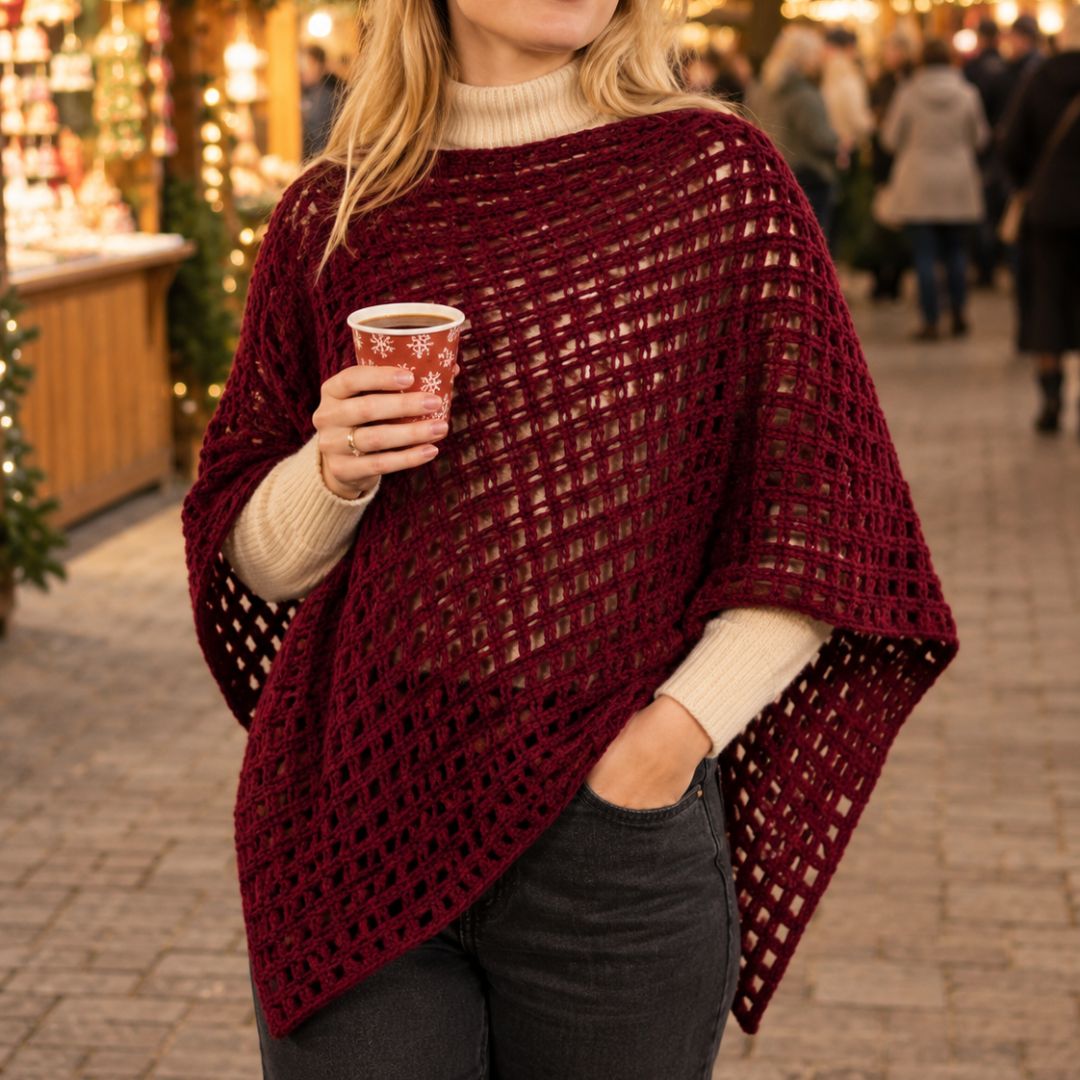
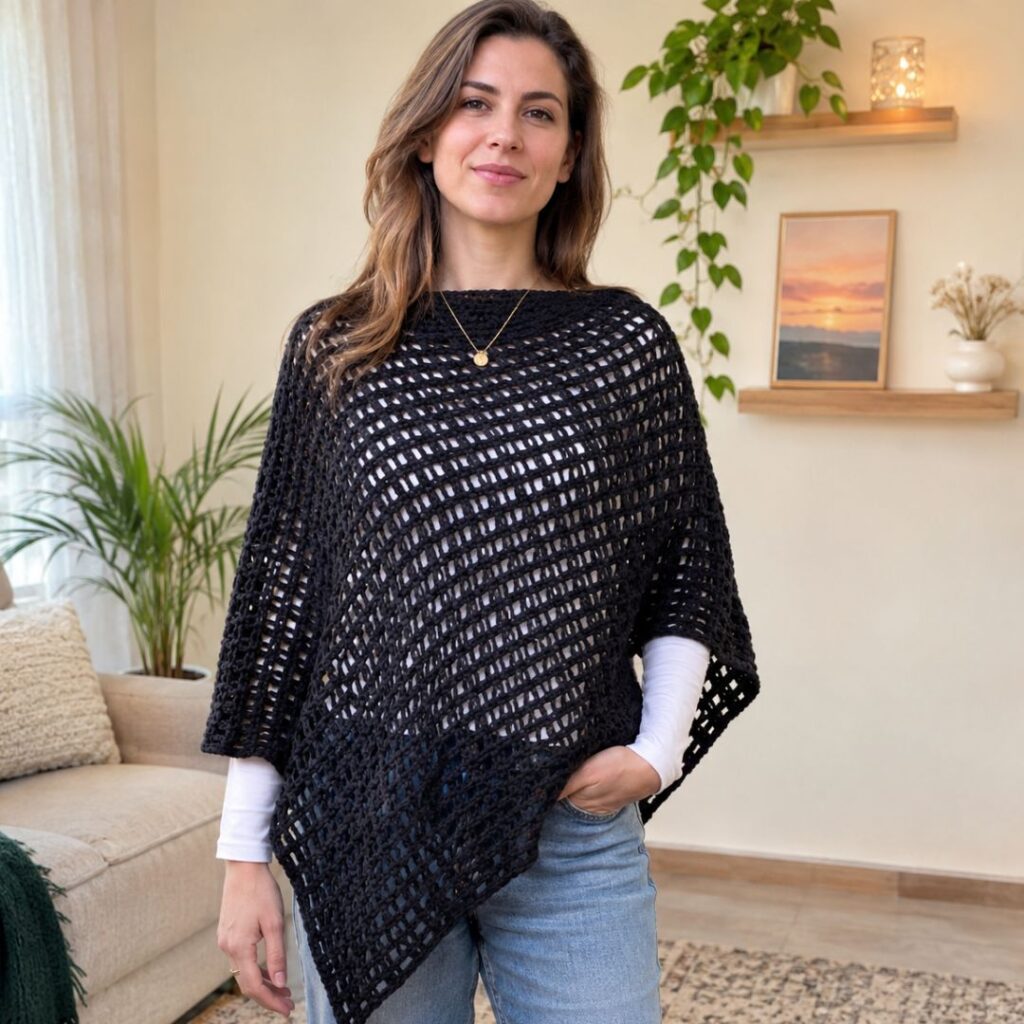
Here’s a secret I love telling new crocheters: some of the most stylish crochet garments are just rectangles in disguise. This poncho is one of them. No sleeves, no shaping, no increases, no decreases. You crochet one long rectangle, fold it in half, join one short seam, and leave a gap for your head. Pop it on and the folded rectangle turns on the diagonal, falling into soft points at the front and back.
If you’ve been wondering how to crochet a poncho, or a first garment of any kind, without a size chart that never quite fits, this is a kind place to start. It looks far more designed than it really is. And because it’s made to measure, it fits your body, not a standard size.
So if you’ve made a scarf or two and you’re ready for something you can actually wear out of the door, this is the one.
🧶 Ready to start? Get the full Everyday Mesh Poncho PDF pattern. It has step-by-step instructions, a made-to-measure sizing guide in inches and cm, and a bonus stitch. Instant download.
🛒 Shop the exact yarn and tools I use → my Amazon storefront.
Quick Info
| Skill level | Beginner-friendly, a lovely first garment |
| Time to make | A “many cosy evenings” project: long rows, but a relaxing rhythm |
| Hook | 5 mm (US H-8) |
| Yarn | Worsted weight (CYC 4), about 4 standard skeins for the sample size |
| Stitches used | Chain, double crochet, slip stitch |
| Sample size | Rectangle 21 × 66 in (53 × 168 cm), head opening 12 in (30 cm) |
| Sizes | Made to measure, for any body |
| Best for | Fall and winter layering, handmade gifts, a summer cover-up in cotton |
Why This Poncho Is Such a Good First Garment
Most first-garment patterns ask a lot: working in the round, increasing for shoulders, matching gauge to a size chart, setting in sleeves. Any one of those is fine on its own. All of them together, on your first wearable, are why so many cardigans stay half-finished in a basket.
This poncho asks for none of them.
- It’s flat until the very end. You crochet one rectangle, back and forth in rows. It only becomes a poncho when you fold and seam it.
- It uses two simple stitches. Chains and double crochet make the whole mesh. A slip stitch joins the seam. That’s it.
- Gauge isn’t critical. The poncho is measured, not counted. You chain to your width and crochet to your length, so matching my tension exactly doesn’t matter.
- The mesh grows quickly. An open stitch covers ground faster than a solid fabric, which keeps you motivated through the long rows.
- It fits real bodies. Instead of picking S, M or L and hoping, you take two body measurements and size the rectangle to you.
And the skills you build here — a long, even foundation chain, straight edges, blocking, a neat seam — are the same ones you’ll use for blankets, wraps and your first sweater.
Who It’s For
Advanced beginners. If you can chain and make a double crochet, you can make this poncho. It’s a confident next step after scarves and dishcloths.
Anyone who’s given up on size charts. If patterns never quite fit you, the made-to-measure sizing is going to feel like a relief.
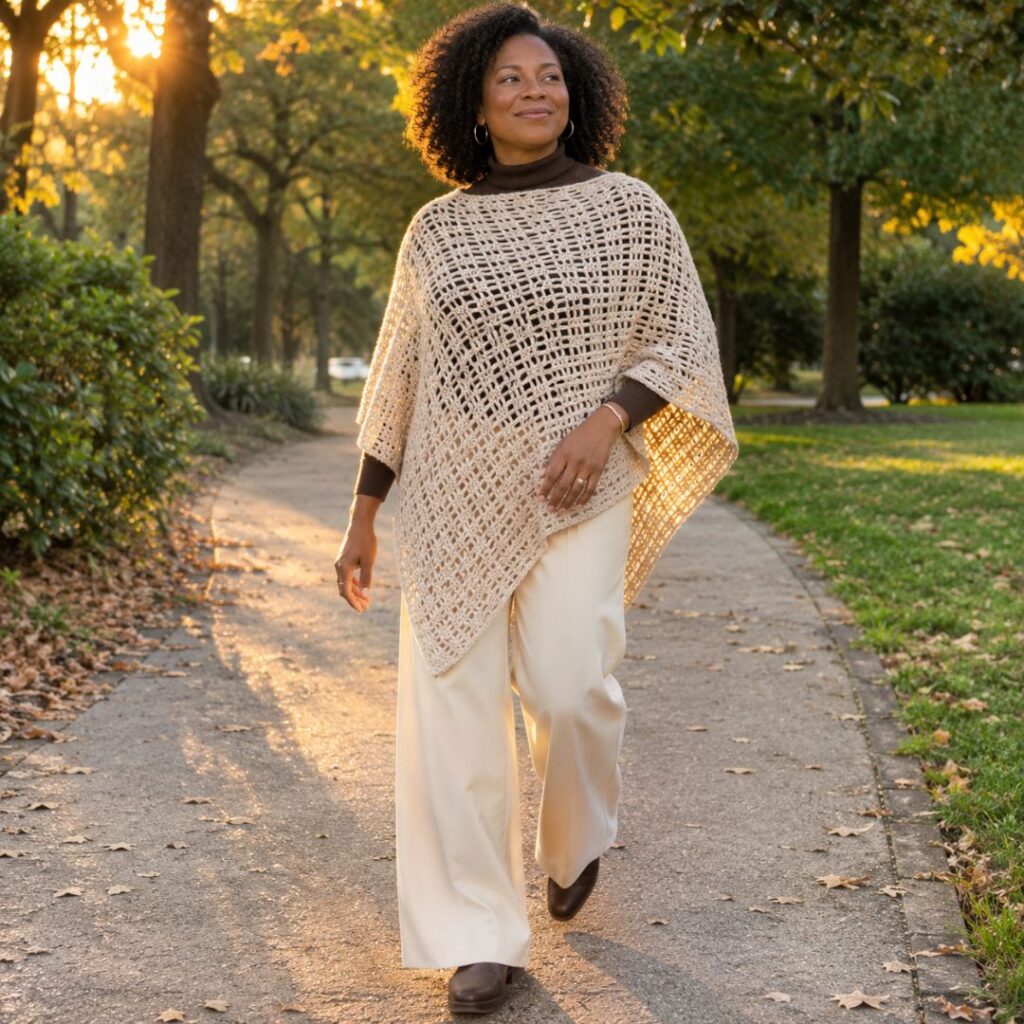
Layering lovers. It sits beautifully over a long-sleeve tee, a turtleneck or a dress with boots, and it moves with you.
Gift makers. Because you size it with two measurements, you can make it for your mum, sister or best friend and know it will fit.
Summer people, too. Make it in a cotton or cotton-bamboo yarn and the mesh becomes an airy beach cover-up.
Materials You’ll Need
As an Amazon Associate I earn from qualifying purchases — at no extra cost to you.
Yarn
Worsted weight yarn (CYC 4, “medium”). The sample size uses about 4 standard skeins of 364 yd / 333 m. Larger ponchos need more, so buy all your skeins from the same dye lot.
- Red Heart Super Saver — the yarn in my sample, in Black. Affordable, hard-wearing, machine washable and available in a huge range of colours.
- Caron Simply Soft — a silkier acrylic with more drape, if you’d like it to hang more fluidly.
- For a softer, lighter version, a cotton-bamboo or wool-cotton blend with a 4 mm hook.
💡 Why worsted acrylic for a first poncho? It’s affordable when you need several skeins, it’s tough enough to be frogged and re-worked without fuzzing, and you can throw the finished poncho in the washing machine. It can feel a little firm straight off the hook, but a gentle steam block relaxes it beautifully.
Hook
- 5 mm crochet hook — the size used for the sample.
- Full crochet hook set — worth it if you’re starting out. It also includes the 4 mm for the lighter version.
Notions
- Darning needle — for weaving in ends.
- Locking stitch markers — for counting your long foundation chain and pinning the seam.
- Scissors — any small sharp pair.
- A tape measure — you’ll use it a lot, because this pattern is sized to you.
🛒 Everything in one place → Shop the Poncho kit on my Amazon storefront.
Stitches & Abbreviations (US Terms)
This pattern is written in US crochet terms. If you learned in UK terms, the names mean different stitches, so check the conversion below.
- ch — chain. Yarn over and pull through the loop on your hook.
- dc — double crochet. Yarn over, insert your hook, yarn over and pull up a loop, then yarn over and pull through two loops, twice.
- sl st — slip stitch. Insert your hook, yarn over and pull straight through the stitch and the loop on your hook.
- sk — skip. Miss that stitch and work into the next one.
US → UK conversion for this pattern:
| US term | UK term |
|---|---|
| chain (ch) | chain (ch) |
| double crochet (dc) | treble crochet (tr) |
| slip stitch (sl st) | slip stitch (ss) |
| skip (sk) | miss |
How to Crochet a Poncho From a Rectangle (Construction Overview)
Here’s how the whole project fits together, so you know exactly what you’d be making.
1. Measure yourself. Stand in front of a mirror and measure from your collarbone, over your shoulder and down your arm to where you’d like the poncho to end. That measurement is the short side of your rectangle. The long side comes from a simple formula in the pattern, and the PDF has a quick size table if you’d rather not do the maths.
2. Crochet the rectangle. You start with a long foundation chain as wide as your rectangle, then work the double crochet mesh back and forth in rows. Each row is the same as the last, so once the first two rows are set up, you’ve learned the whole thing. You keep going until the rectangle is as tall as your first measurement.
3. Block it. A gentle steam (for acrylic) or a soak (for wool and cotton) relaxes the mesh so it drapes softly.
4. Fold and seam. Fold the rectangle in half, short end to short end. Along one long edge, you slip stitch the two layers together from the open corner, stopping a set distance before the fold. That gap is your head opening.
5. Turn it out and wear it. The seam sits along one shoulder and arm, and the poncho falls on the diagonal into its soft points.
That’s the whole build: one rectangle, one fold, one seam.
What’s Inside the PDF Pattern
The overview tells you what you’d be making. The PDF walks you through actually making it, written for someone making their first garment.
Inside the 25-page ebook:
- ✅ The complete step-by-step pattern, with stitch-count checks so you can catch mistakes early
- ✅ A “finding your size” guide with the measure-to-fit formula and a size table for short sides from 18 to 26 in (46–66 cm)
- ✅ A tip for a lighter version with less fabric at the sides
- ✅ Every measurement in inches and centimetres
- ✅ Conversion tables: US/UK terms, hook sizes, yarn weights and inches/cm
- ✅ A printable one-page pattern summary card
- ✅ Step-by-step photo guidance through the foundation chain, the first rows, the fold and the seam
- ✅ A blocking guide for acrylic (steam) and natural fibres (wet blocking)
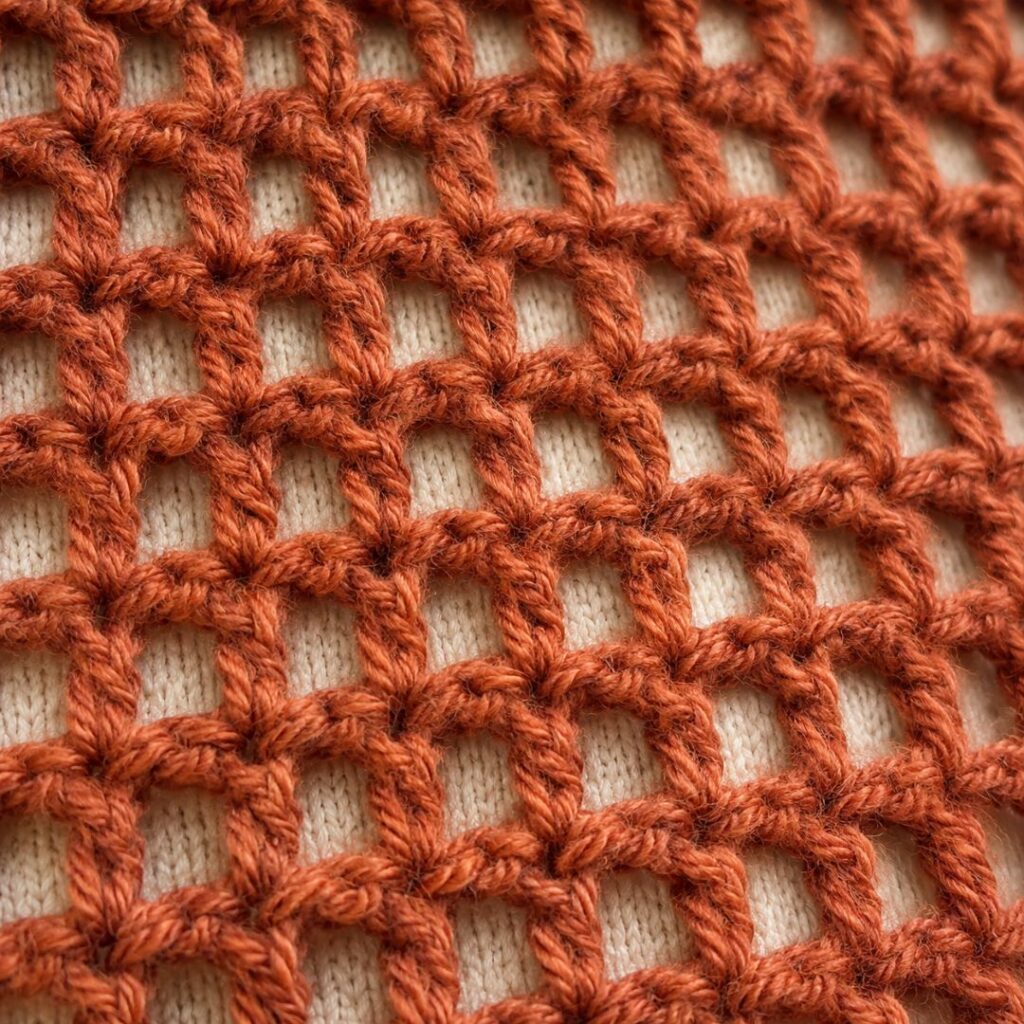
- ✅ A bonus stitch: the textured mixed woven mesh, written row by row
- ✅ Tips shared by other makers
- ✅ A troubleshooting section covering 10 common snags, from edges that slant to a puckered seam
- ✅ A variations chapter: cropped, longer, stripes, colour blocking, fringe and more
- ✅ Full care instructions
- ✅ A little welcome gift tucked inside, as a thank-you
🧶 Get the Everyday Mesh Poncho pattern
Download the PDF pattern here →
Instant download. Print it or keep it on your phone. Yours forever.
Tips & Care
A few things worth knowing for any mesh garment.
Keep your foundation chain loose. A tight chain pulls the bottom edge in. If your chains are tighter than your stitches, make the chain with a hook one size bigger, then switch back.
Count often, especially early on. A quick count every few rows catches a missed stitch before your edges start to slant.
Measure flat. Lay your work on a table and smooth it gently without stretching. Mesh stretches out of shape when you hold it up to measure.
Join new yarn at the end of a row. It’s much tidier to weave in at the side edge than in the middle of the mesh.
Washing. Acrylic: machine wash cold on a gentle cycle, ideally in a mesh laundry bag, then lay flat to dry. Wool and cotton blends: hand wash cool and lay flat. Never hang a wet mesh garment, because it stretches.
Storage. Fold it, don’t hang it, so it keeps its shape.
Patterns You Might Love Next
- Twist Ear Warmer Pattern — a one-evening winter make to wear with your poncho.
- Sophie Hood Scarf Pattern — another cosy layering piece for colder days.
- Cozy Fall & Winter Pattern Bundle — several winter patterns together, for less than buying them one by one.
Frequently Asked Questions
Can a beginner really crochet a poncho? Yes. This one is a flat rectangle made with chains and double crochet, with no shaping. If you’ve finished a scarf, you’re ready.
How much yarn do I need? About 4 standard skeins of worsted weight yarn for the sample size (21 × 66 in / 53 × 168 cm). Larger ponchos need more.
Do I need to match the gauge? No. The poncho is measured, not counted: you chain to your width and crochet to your length. Just keep your tension consistent.
Will it fit me? Yes. You size the rectangle from your own measurements, so the same pattern works for any body. The PDF includes the formula and a size table.
Can I make a summer version? Yes. A cotton or cotton-bamboo yarn with a 4 mm hook turns the mesh into a light, airy cover-up.
What’s the difference between a rectangle poncho and a regular poncho? A regular poncho is often two panels, or worked in the round with shaping. A rectangle poncho is one piece folded and seamed, which makes it simpler to crochet and gives the asymmetrical drape.
Can I sell what I make? Yes, finished items are welcome to sell. The pattern file itself is for personal use, not resale or sharing.
Your Turn
There’s something special about wearing the first garment you’ve ever made: catching sight of it in a shop window, someone asking “where did you get that?”, and getting to say “I made it.”
This poncho is designed to get you there. One rectangle, two stitches, one seam, and a fit made for you.
If you make one, I’d love to see it. Tag @crochetmoderndesign and tell me which colour you chose.
Happy crocheting, Elowen 🧡 Crochet Modern Design